
In large warehouses in remote areas, rows of machines run around the clock, fans roaring, lights blinking. These are bitcoin mines.
Many people have heard of "mining" without knowing what the machines actually do. They aren't digging anything up. They're competing in a global computing race. The winner records the next page of the ledger and earns newly issued bitcoin as a reward.
That race is what keeps bitcoin secure without any central authority.
Key takeaways
- Mining is how bitcoin keeps its ledger: miners compute repeatedly to win the right to add a block, earning the block reward plus fees.
- More hashrate means better odds of finding a block, and the higher the network's total hashrate, the costlier it is to attack.
- Bitcoin adjusts mining difficulty every 2,016 blocks (about two weeks) to keep blocks coming roughly every 10 minutes.
- After the 2024 halving, the block reward is 3.125 bitcoin, and home mining often can't cover electricity and hardware costs.
- Mining is restricted or banned in some places, and "cloud mining" is a common scam.
What miners are actually computing
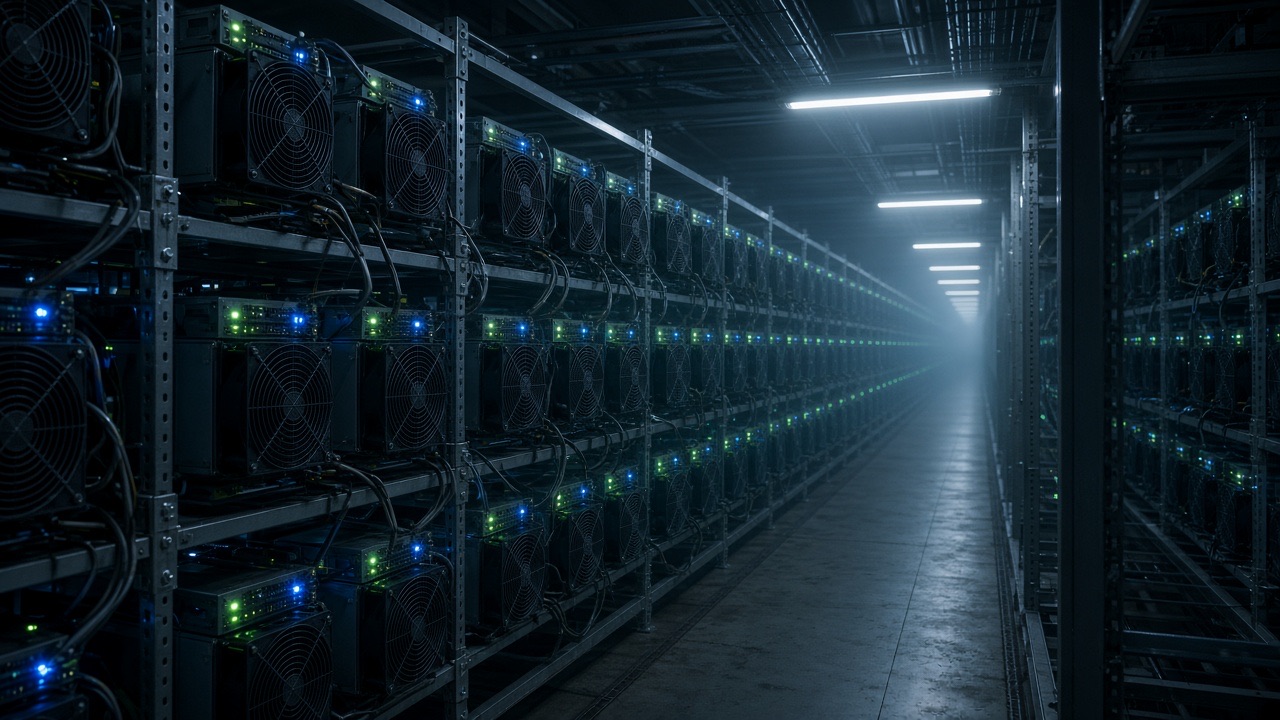
Bitcoin's ledger is made of blocks, each holding a batch of transactions. Who gets to add the next block? Bitcoin decides with proof of work.
Put simply, miners keep trying different random numbers, feeding the block data through the SHA-256 hash function until the result comes out below a target value. There's no shortcut. You just keep trying, like rolling dice until you get a small enough number.
Whoever finds a valid result first wins the right to add that block and receives:
- The block reward: newly issued bitcoin, 3.125 per block since the 2024 halving.
- Transaction fees: the fees paid by every transaction in the block.
Other nodes can verify the result instantly, so nobody can fake it. For bitcoin's fundamentals, read what is Bitcoin? Blockchain, mining and the halving.
Hashrate: measuring mining power
Hashrate is how many hash calculations can be performed per second.
| Unit | Meaning |
|---|---|
| TH/s | One trillion hashes per second; typical for a single miner |
| PH/s | 1 PH/s = 1,000 TH/s |
| EH/s | 1 EH/s = 1,000 PH/s; typical for the whole network |
| ZH/s | 1 ZH/s = 1,000 EH/s |
Total network hashrate has kept climbing in recent years, reaching hundreds of EH/s and approaching 1 ZH/s around 2025. The higher the network hashrate, the more it costs to control most of it and rewrite the ledger (a "51% attack"), and the more secure bitcoin becomes.
Difficulty adjustments: keeping blocks at 10 minutes
If more and more machines join and compute faster, wouldn't blocks come faster and faster? Bitcoin solves that with difficulty adjustments.
- Every 2,016 blocks (about two weeks at 10 minutes per block), the network adjusts mining difficulty based on how fast blocks actually arrived.
- Blocks too fast? Difficulty rises. Too slow? It falls.
- Each adjustment is capped: at most 4x or one-quarter of the previous difficulty.
The mechanism is remarkably robust. When mainland China banned bitcoin mining in 2021, network hashrate fell by about half and blocks slowed noticeably. After a few downward difficulty adjustments, block times returned to normal, and the network never stopped.
What miners earn and spend: the real math
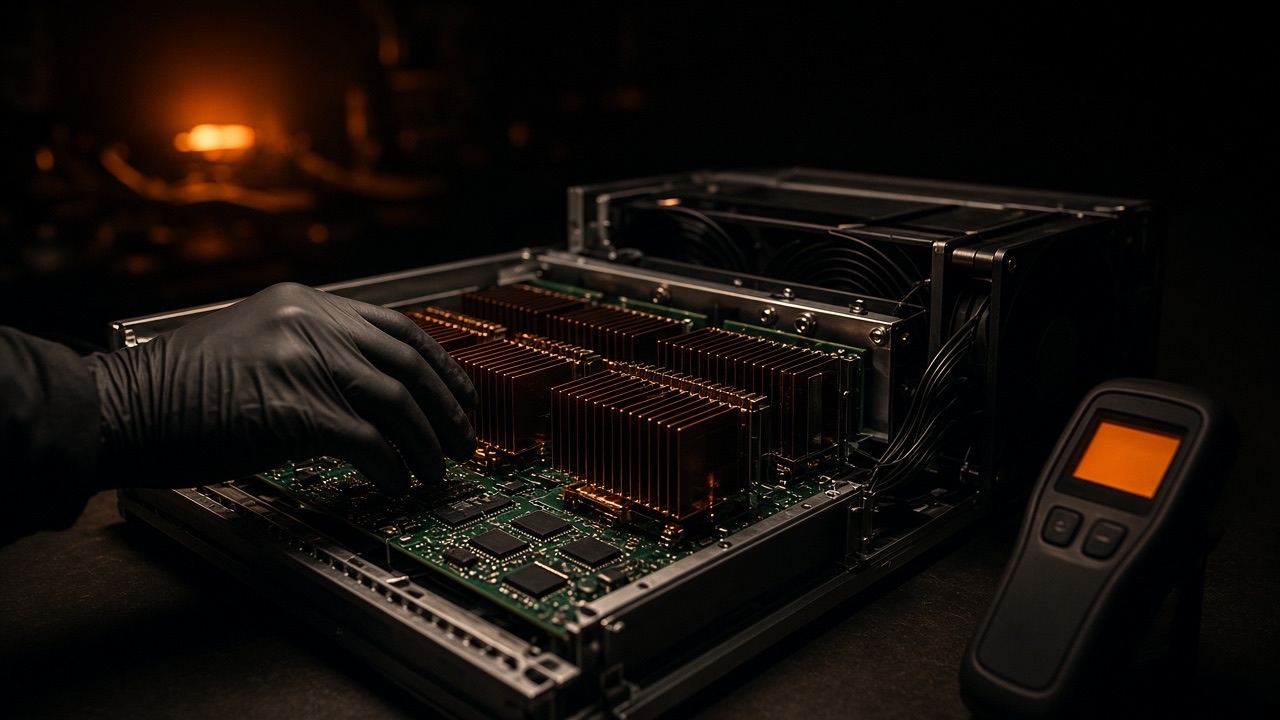
Here's a simplified estimate of one machine's daily economics. Assume:
- The miner does 200 TH/s at 17.5 J/TH, drawing about 3,500 watts.
- Network hashrate is 1,000 EH/s.
- Bitcoin trades at $80,000, and about 450 new bitcoin are mined per day (144 blocks × 3.125).
The machine's share of network hashrate is 200 TH/s ÷ 1,000 EH/s = 0.00002%, so it earns about 450 × 0.0000002 = 0.00009 bitcoin a day, or about $7.20.
It uses 3.5 kW × 24 hours = 84 kWh of electricity a day:
| Electricity price (per kWh) | Daily power cost | Daily gross profit (approx.) |
|---|---|---|
| $0.05 | $4.20 | $3.00 |
| $0.08 | $6.70 | $0.50 |
| $0.12 | $10.10 | −$2.90 |
Note: this is a simplified estimate. It excludes transaction fee income, pool fees, hardware purchase costs, maintenance and cooling, and real results change with bitcoin's price, network hashrate and difficulty.
The takeaway: electricity price almost single-handedly decides whether mining pays. Professional operations seek out extremely cheap power and buy the newest, most efficient machines in bulk. For ordinary people paying residential rates, home mining often can't even cover the power bill, let alone the cost of the machine.
The risks of home mining and cloud mining
- Earnings rarely cover costs: electricity, hardware depreciation and rising difficulty eat into profits. After each halving, the same hashrate earns half the block reward.
- Noise and heat: miners are loud and run hot, which makes them poorly suited to a home.
- Cloud mining scams: many "cloud mining" platforms promise passive income from rented hashrate. Some have no machines at all and pay early users with new users' money until they vanish.
- Legal risk: some jurisdictions restrict or ban crypto mining. Check your local rules first.
FAQ
Can I mine bitcoin with a regular computer or graphics card?
In theory, yes. In practice, you'd almost never find a block. Bitcoin mining moved to specialized machines (ASICs) long ago, and a regular computer or GPU is millions of times slower, so the electricity costs far outweigh any possible reward.
Is bitcoin mining a waste of energy?
It's a long-running debate. Critics argue mining consumes enormous amounts of electricity. Supporters say that energy buys a secure network without a central authority, and that more mines are using hydropower and surplus wind and solar. Both views are worth understanding.
What is a mining pool?
A single miner's odds of finding a block are tiny, so income would be wildly irregular. A pool combines many miners' hashrate and splits block rewards by each one's contribution, giving steadier income in exchange for a pool fee.
Will mining continue after all bitcoin is mined?
Yes. Miners will then earn only transaction fees. For the full halving timeline, read Bitcoin halving history: does the four-year cycle hold?
Summary
Bitcoin mining is a global computing race: miners compete with hashrate to add blocks, difficulty adjustments hold blocks at about 10 minutes, and the network's combined hashrate protects the ledger. But with halvings and fierce competition, mining has become a professional business built on cheap power and scale, and home miners and cloud mining customers rarely come out ahead. This article is for education only and isn't investment advice.

Covers Bitcoin: the protocol, mining, the halving cycle and network development, writing from the white paper and verifiable on-chain data.
Our editorial principles →
 David Mitchell

 Sarah Collins