
Every time an exchange blows up, the same chorus rings out across crypto: "Not your keys, not your coins! Move it to cold storage!"
They have a point. From Mt. Gox to FTX, exchange failures have shown the risks of custody again and again. But the second half of the sentence rarely gets said: once your coins are in a cold wallet, the only thing that can save you is your seed phrase.
So how much safer is a cold wallet, really? And is self-custody freedom, or a burden many people aren't ready for?
Key takeaways
- Cold wallets and exchanges face completely different kinds of risk, so "which is safer?" has no simple answer.
- Exchange risks: hacks, insolvency, misuse of customer funds and frozen accounts.
- Cold wallet risks: lost or leaked seed phrases, tampered devices, user error and scams.
- For knowledgeable, disciplined users, cold wallets are usually safer. For beginners, not necessarily.
- The real cost of self-custody is ongoing attention and responsibility.
Exchange risk: someone else holds the keys
Keeping crypto on an exchange means letting the platform hold your private keys. The balance in your account is essentially an IOU.
History shows how often that IOU has failed:
| Year | Event | Outcome |
|---|---|---|
| 2014 | Mt. Gox collapse | About 850,000 BTC lost; creditors waited roughly a decade for repayment |
| 2018 | Coincheck hack (Japan) | About $530 million in NEM stolen |
| 2022 | FTX collapse | Customer funds misused; withdrawals frozen for countless users |
| 2025 | Bybit hack | About $1.5 billion in ether stolen, one of the largest crypto thefts on record |
Exchange risk falls into four buckets: hacks, business failure, insider misuse and frozen accounts. What they share: you can't control them, and you rarely see them coming.
After FTX, more exchanges began publishing "proof of reserves," using on-chain data to show they hold enough customer assets. That's progress, but it shows a snapshot in time and doesn't eliminate risk entirely.
Cold wallet risk: you hold the keys, and the responsibility
A cold wallet keeps your private keys on an offline device and signs transactions internally, so the keys never touch an internet-connected computer or phone. Technically, that all but eliminates remote theft.
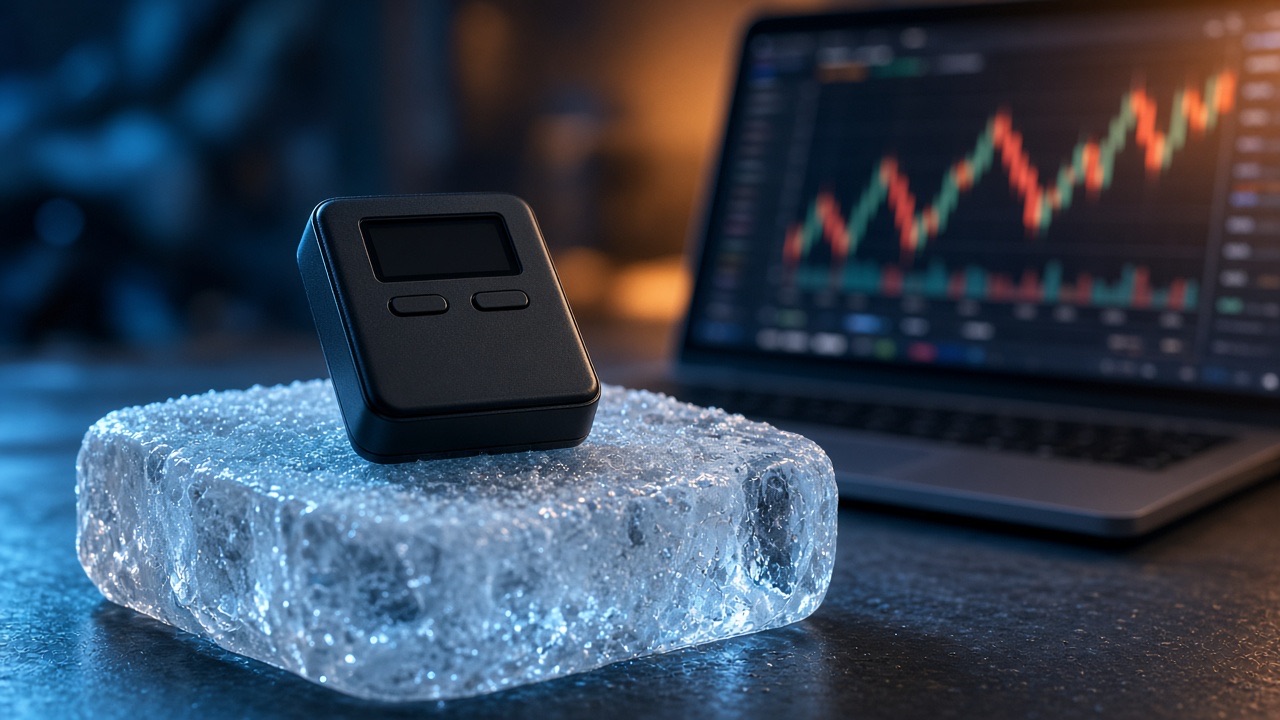
But cold wallets have risks too. They just look different:
- Lost seed phrase: if the device breaks or goes missing, only the seed phrase can restore it. Lose both and the funds are gone forever.
- Leaked seed phrase: photographed, seen by someone at home or typed into a phishing site, and your funds are gone within minutes.
- Supply chain risk: devices from unofficial sellers may be tampered with, sometimes shipped with a "pre-set" seed phrase.
- User error: wrong address, wrong network or a signature you didn't understand.
- Social engineering: fake support, fake firmware updates and fake official emails designed to get your seed phrase.
Notice the pattern: nearly all cold wallet risk sits with the person, not the device. The hardware is hard to break. People are easy to fool.
Side-by-side risk comparison
| Risk | Exchange | Cold wallet |
|---|---|---|
| Remote hacking | Higher; exchanges are prime targets | Very low; keys stay offline |
| Platform failure or misuse | Possible | Not applicable |
| Frozen account | Possible | Not applicable |
| Forgotten password | Recoverable via ID verification | Only the seed phrase works |
| Your own mistakes | Sometimes fixable via support | Almost never fixable |
| Tricked into giving up credentials | Fraud monitoring and 2FA as a backstop | No backstop at all |
| Inheritance | A relatively clear process | Depends entirely on your planning |
So "cold wallets are safer than exchanges" is more accurately: cold wallets remove platform risk, but leave all of the personal risk with you.
Self-custody: freedom or burden?
Self-custody advocates value freedom: nobody can freeze your funds, nobody can misuse your money and you can send it anywhere, anytime, without permission.
But that freedom comes with a long-term weight:

- You have to remember: where your seed phrase is, what your PIN is and how everything works.
- You have to stay alert: every DM, every link and every signature could be a trap.
- You have to plan for the unexpected: if you get sick or die, can your family take over?
- There's no safety net: make a mistake and there's no help line to call and no bank to dispute it with.
For some people, total control is where their peace of mind comes from. For others, it's a constant source of anxiety. Which option is safer depends heavily on which kind of person you are.
A practical middle ground: tiered storage
Instead of choosing between "everything on an exchange" and "everything in cold storage," split your crypto by purpose:
| Purpose | Where to keep it |
|---|---|
| Short-term trading | A reputable exchange, with 2FA and a withdrawal allowlist |
| Everyday spending | A mobile hot wallet |
| Most long-term holdings | A cold wallet, with multiple offline seed phrase backups |
| Very large holdings | Cold wallet + passphrase, or a multisig wallet |
If one tier runs into trouble, the damage stays contained.
FAQ
Can hackers attack a cold wallet remotely?
When used properly, a cold wallet's keys never leave the device, which makes remote theft extremely difficult. But if you sign a malicious approval on a phishing site, or type your seed phrase into a connected device, the cold wallet can't protect you.
If an exchange publishes proof of reserves, is it safe?
Proof of reserves improves transparency, but it usually reflects a single point in time and may not fully capture liabilities. It lowers risk; it doesn't eliminate it.
What should I watch for when buying a cold wallet?
Buy only from the manufacturer or an authorized reseller, and never secondhand. Check the packaging for tampering. A device that comes with a pre-set seed phrase is always a scam. Let the device generate a new seed phrase when you first set it up.
Should beginners start with a cold wallet?
Not necessarily. Practice creating, backing up, restoring and sending from a wallet with a small amount first. Once you're confident you can manage a seed phrase, move larger holdings into cold storage.
Summary
Cold wallets do eliminate the risk of exchange hacks, collapses and freezes, but they hand full responsibility for your security to you. They're safer only if you can manage your seed phrase and avoid getting scammed.
Self-custody is both freedom and burden. The right approach is finding your balance: tiered storage, multiple backups and planning ahead. For a full introduction to wallets, read our crypto wallet guide. This article is for education only and isn't investment advice.

Covers security and beginner guides: wallet safety, key management, phishing and approval risks, helping readers avoid the most common ways to lose funds.
Our editorial principles →
 Sarah Collins

 David Mitchell